



AI in Legal Tech: Reducing Case Screening Time by 60% with NLP
NLP-powered case screening cuts legal intake time by 60% and per-case costs from $1,300 to $305. Here's what that workflow change actually looks like — and why most firms still haven't made it.
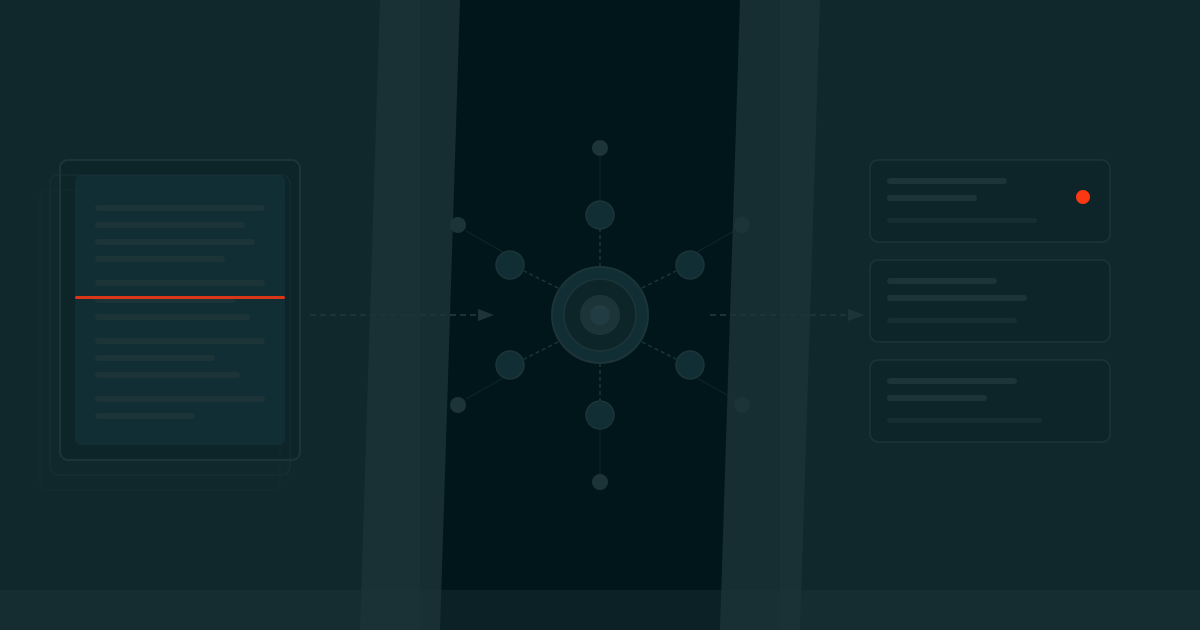
Quick Answer: NLP-powered case screening tools analyze intake documents, extract key facts, and surface case viability signals in seconds rather than hours. Firms deploying purpose-built legal NLP report 60% reductions in screening time, per-case processing costs dropping from roughly $1,300 to $305, and intake staff redirected from data entry to client-facing work.
A mid-sized litigation firm received 340 case inquiries in January 2025. Their intake team spent four full working days reading through them, pulling out dates, injuries, liability signals, and statute-of-limitations flags — all by hand. They accepted 31 cases. The other 309 were rejected, referred out, or lost in the queue entirely.
That's not a staffing problem. It's a process problem, and NLP solves it at the root.
Legal intake has always been a bottleneck because it requires reading comprehension at scale — something humans do slowly and expensively, and something that modern natural language processing does well. By 2026, the firms that've closed this gap aren't outliers. They're the benchmark everyone else is being measured against.
This article covers how NLP actually works inside legal case screening, where the real time savings come from, what the cost math looks like, and what separates successful implementations from expensive shelf-ware.
What 60% Actually Means for a Legal Practice
When practitioners say NLP cuts case screening time by 60%, they're describing a specific workflow change: the system reads, tags, and scores an intake document before a human ever opens it. The attorney or paralegal sees a structured summary instead of raw text.
That shift matters more than the percentage suggests. Screening isn't just slow — it's cognitively expensive. Every hour a senior associate spends reading intake forms is an hour not spent on billable case work. At US law firm billing rates averaging $350–$550 per hour for associate time, manual screening carries a real opportunity cost that never shows up on a cost-per-inquiry spreadsheet.
The 60% figure comes from firms running NLP against their actual intake volumes. Luminance's hybrid NLP technology, used across a network of mid-sized firms, produced a 73% accuracy improvement on clause identification while cutting per-case screening costs from $1,300 to $305. That's not a pilot number — it's a production figure from firms processing hundreds of cases monthly.
LegalMation's document automation platform reports cutting response time on discovery requests by more than 50%, reaching 80% in high-volume practices. Harvey AI's most engaged users are saving 30–88 hours per user per month across legal research and document review tasks. These aren't the same as pure intake screening metrics, but they're measuring the same underlying capability: NLP reading legal text so attorneys don't have to.
How NLP Reads Legal Language Differently Than Search
Standard search finds documents containing specific keywords. NLP understands what those keywords mean in context — and that distinction is what makes it useful for case screening rather than just document retrieval.
When a personal injury intake form says "the vehicle entered the intersection at approximately 35 miles per hour before impact," keyword search finds "vehicle" and "impact." NLP understands that this is a liability indicator, that "approximately" signals witness uncertainty, and that the absence of weather conditions in the same paragraph is a data gap worth flagging.
Modern legal NLP platforms combine three layers of processing. The base layer is named entity recognition — identifying parties, dates, jurisdictions, and dollar amounts automatically. The second layer is semantic classification, where the system maps language to legal concepts: "the defendant failed to warn" maps to a product liability theory regardless of how the sentence is phrased. The third layer is contextual scoring, where the platform evaluates completeness — does this intake contain enough information to assess case viability, or are critical facts missing?
This is why legal-specific NLP outperforms general-purpose models on intake tasks. A 2025 benchmark study published by Vals AI found that legal-domain models outperformed both generalist AI and the human lawyer baseline on legal research accuracy. The gap wasn't marginal — domain-trained models consistently performed better across structured legal reasoning tasks where context and terminology precision matter. For intake screening specifically, that domain specificity is the difference between a useful pre-screening tool and a system that generates false positives your team then has to manually review anyway.
If you're exploring how modern AI agent architectures underpin these domain-specific capabilities, our breakdown of Claude agent architecture covers the technical foundations worth understanding before evaluating platforms.
Where Screening Time Goes — and Where AI Takes It Back
To understand where the 60% comes from, you need to map where intake time actually goes. Most firms have never done this explicitly, which is why the number surprises them when they finally measure it.
Typical manual screening time breakdown per case inquiry:
| Task | Manual Time (avg) | With NLP Pre-Processing | Time Saved |
|---|---|---|---|
| Reading intake form | 12–18 min | 2–3 min (reviewing summary) | ~80% |
| Extracting key facts (dates, parties, injuries) | 8–12 min | Automated | ~100% |
| Statute of limitations check | 5–10 min | Automated flag | ~90% |
| Conflict-of-interest check | 3–6 min | Automated (integrated CRM) | ~85% |
| Case viability scoring / triage decision | 5–8 min | 3–5 min (reviewing AI score) | ~35% |
| Data entry into case management system | 6–10 min | Automated population | ~95% |
The total per-inquiry time drops from roughly 39–64 minutes to 5–8 minutes. At 340 monthly inquiries, that's the difference between four days of intake labor and half a day.
What NLP doesn't fully replace is the triage decision itself — the moment where an experienced attorney weighs case strength against firm capacity, current docket, and client fit. That judgment benefits from AI-generated summaries and scores, but it still requires a human with legal expertise and firm context. The best implementations treat NLP as a pre-screening layer, not a replacement for attorney discretion.
Cost Breakdown: Manual Screening vs. NLP-Assisted Screening
The ROI conversation for legal NLP usually starts in the wrong place — vendors quote platform costs against license fees instead of against the actual labor they're replacing. Here's how the numbers look when you model them honestly.
Annual cost comparison: 250-inquiry/month intake volume
| Cost Element | Manual Process | NLP-Assisted Process |
|---|---|---|
| Paralegal / intake staff time (at $65/hr blended) | ~$156,000/yr | ~$26,000/yr |
| Senior associate review time (at $350/hr) | ~$84,000/yr | ~$16,800/yr |
| NLP platform license (mid-market) | $0 | $18,000–$36,000/yr |
| Implementation + training | $0 | $8,000–$15,000 (one-time) |
| Error costs (missed SOL, data entry mistakes) | Estimated $20,000–$60,000/yr | Estimated $4,000–$12,000/yr |
| Total Annual Cost | ~$260,000–$300,000 | ~$65,000–$90,000 |
The payback period on a mid-market NLP platform at this intake volume is typically under six months. Firms that have completed the transition report most of their ROI coming from two sources: recovered senior associate time (which flows back into billable work) and improved case acceptance rates from faster response times to high-value inquiries.
That second point deserves more attention than it gets. Potential clients who submit intake inquiries and receive a response within four hours are significantly more likely to retain the firm than those who wait 24–48 hours while manual screening proceeds. At a firm with a 15% intake-to-client conversion rate and an average case value of $45,000, improving response speed on the top 20% of inquiries by even one day changes the revenue math considerably.
The Adoption Gap: Why 80% of Firms Still Screen Manually
Here's where I'd push back on the conventional narrative: the slow adoption of legal NLP isn't primarily a technology problem. Most platforms available today are genuinely capable. The gap is organizational.
According to the 2025 Legal Industry Report published by the American Bar Association, large firms report only a 39% generative AI adoption rate — and adoption at firms with 50 or fewer lawyers sits around 20%. A 2025 Bloomberg Law survey found that 60% of in-house legal teams don't even know if their outside counsel are using AI on their matters. That's not technophobia — it's change management failure at scale.
The three real barriers practitioners report:
- Hallucination risk on legal facts. Attorneys are professionally liable for factual errors. When a 2025 National Center for State Courts guide identified AI hallucinations as the primary concern for legal practitioners, it captured something real: the fear isn't that AI is bad, it's that errors in legal work have professional consequences that errors in a marketing email don't. NLP-based screening tools that extract and present facts — rather than generating new text — carry substantially lower hallucination risk than generative tools, but this distinction isn't always communicated clearly by vendors.
- No clear owner for the implementation. Buying a legal AI platform requires someone to own the integration with existing case management software, train staff, establish quality-control workflows, and iterate on the model's performance. Most small and mid-sized firms don't have a dedicated legal operations function.
- The pilot trap. 2026 represents a shift identified by Everlaw, Artificial Lawyer, and Bloomberg Law independently: firms that ran one-year pilots between 2023 and 2025 without committing to production deployment got almost none of the ROI. The technology works at scale. It doesn't work when it's treated as optional and used inconsistently.
The firms seeing the real gains — 60%+ time reductions, sub-six-month payback — committed to full integration: NLP connected to their case management system, trained on their practice area's document types, with a clear workflow that every intake staff member follows consistently. Partial adoption produces partial results.
For firms navigating this kind of organizational implementation challenge, our 90-day digital acceleration program covers the change management and integration architecture that determines whether a new AI system actually gets used.
What Good Implementation Looks Like in Practice
The difference between a successful legal NLP deployment and an expensive experiment usually comes down to four decisions made before the platform is purchased.
Step-by-step implementation checklist:
- Define your screening criteria explicitly. Before any NLP system can score case viability, you need your own criteria documented: what makes a case worth accepting, what disqualifies it, what data points are non-negotiable vs. nice-to-have. Most firms discover they've never written this down. The NLP implementation forces the conversation.
- Audit your intake document types. NLP performs differently on structured forms versus free-text emails versus scanned PDFs. Build an inventory of your actual intake channels and formats before evaluating platforms — a system optimized for web-form intake won't perform the same way on phone-call transcripts.
- Choose integration depth intentionally. Surface-level integration (AI produces a summary, staff manually copies it to your CMS) captures about 30% of the available time savings. Deep integration (AI populates your case management system directly) captures 80%+. The deeper integration requires more implementation effort but delivers proportionally more ROI.
- Establish a human review layer for the first 90 days. Have a senior attorney spot-check 10–15% of AI-scored intakes against their own assessment. This builds confidence in the system's accuracy on your specific document types, surfaces systematic errors early, and gives you the data to demonstrate ROI internally — which matters for sustaining buy-in when the implementation disrupts established habits.
- Set response-time SLAs from day one. The speed advantage of NLP is only captured if your workflow actually uses it faster. Firms that installed NLP but kept a 48-hour intake review cycle got efficiency gains on staff time but didn't capture the conversion benefits of faster client response.
Our SmartLegal case study covers a legal-adjacent deployment where we built an NLP-assisted document processing system that handled intake classification end-to-end — a concrete example of what the integration architecture looks like in practice.
For a broader look at how AI agents handle multi-step document workflows, our guide to Claude skills architecture explains the component structure that makes these systems composable and maintainable.
Challenges Worth Naming Before You Buy a Platform
The case for legal NLP is strong enough that the risks are worth stating plainly rather than burying in footnotes.
Pros and Cons of NLP Case Screening
| Pros | Cons |
|---|---|
| 60–80% reduction in per-case screening time | Upfront integration cost and staff training time |
| Consistent application of screening criteria | System performs differently across document formats |
| Automated statute-of-limitations flagging | Requires explicit criteria documentation before deployment |
| Faster client response improves conversion rates | Legal-specific platforms carry significant licensing costs |
| Senior associate time freed for billable work | Partial adoption delivers partial results — all or nothing |
| Reduces data entry errors and missed deadlines | Hallucination risk on generative components needs oversight |
The hallucination issue is the one most worth treating carefully. NLP that extracts and classifies text — "this document mentions a date of March 14, 2023" — is reliable in a way that generative text — "based on this intake, the likely damages are..." — is not. As you evaluate platforms, this distinction matters practically. Extraction-based NLP for intake pre-processing carries low professional risk. Generative drafting tools operating without attorney review carry more. Most serious legal AI deployments in 2026 use extraction-based NLP at the screening layer and reserve generative capabilities for assisted drafting with mandatory attorney review.
The EU AI Act's full application to high-risk systems in August 2026 also adds a compliance dimension for firms operating in European markets. Systems used for legal decisions that affect individuals may fall under high-risk classifications requiring conformity assessments and documented human oversight. If your firm has EU-based clients or operates across jurisdictions, this is worth building into your implementation timeline now rather than retrofitting later. Our GDPR vs. CCPA breakdown for conversational AI covers what EU and US regulations actually require from your legal AI deployment.
On the competitive side: the market for legal AI tools nearly doubled from $1.5 billion in 2024 to over $3 billion in 2025. That growth means more platforms, more vendor claims, and more pressure to move quickly. The firms getting the most from legal NLP aren't the ones who moved fastest — they're the ones who moved most deliberately, matching platform capabilities to their actual document types and intake volumes before committing.
For firms who want a rapid assessment of whether their current intake process is NLP-ready without committing to a full implementation, our 2-week design sprint can map your intake workflow, identify the highest-value automation points, and produce a technical specification for the integration — before you spend anything on platform licensing.
You can also see how we've approached AI system builds for legal-adjacent clients including Alethia and BEUC, both of which required classification and extraction capabilities applied to complex document corpora.
The broader question of when to build vs. buy for legal AI is one that domain experts in the space have been working through with us directly. We co-build AI businesses with people who have deep legal expertise — they bring the domain knowledge, we bring the infrastructure. If you're a legal tech founder or a managing partner thinking about building a proprietary screening system rather than licensing one, the legal AI industry guide covers where the build-vs-buy calculus is shifting in 2026.
Frequently Asked Questions
How does NLP differ from keyword search in legal document review?
Keyword search finds documents containing specific terms. NLP understands the meaning and context of those terms — mapping language to legal concepts regardless of phrasing, identifying relationships between facts, and flagging gaps in required information. A system that understands "the manufacturer had prior knowledge of the defect" maps to product liability doctrine even if the intake form never uses legal terminology.
What intake volume justifies investing in a legal NLP platform?
Most platform providers quote break-even at roughly 100–150 inquiries per month for mid-market tools. Below that, a well-structured intake form with manual review may be more cost-effective. Above 200 monthly inquiries, the labor cost of manual screening typically exceeds platform licensing within the first year, and the conversion benefit of faster response times adds additional ROI that accelerates payback to under six months.
Does NLP perform differently across practice areas?
Yes, substantially. Personal injury, immigration, and criminal intake are highest-volume, most structured, and best-suited for NLP screening because intake documents follow predictable patterns. Complex commercial litigation and M&A matters involve more varied document types and jurisdiction-specific nuance that requires domain-specific model training. Most platforms offer practice-area-specific models — confirm that the platform you evaluate has training data relevant to your specific document types before signing a contract.
What's the professional liability exposure when AI makes a screening error?
The risk depends on how the system is positioned in your workflow. NLP used as a pre-screening filter — surfacing summaries and flags for attorney review — doesn't create direct professional liability as long as a qualified attorney makes the final intake decision. NLP used to automatically decline cases without attorney review could create liability if a viable case is wrongly rejected. Every serious legal AI deployment in 2026 includes a human review gate at the final triage decision. The time savings come from pre-processing, not from removing attorney judgment from the process.
How does the GDPR and EU AI Act affect legal NLP deployments in 2026?
If your intake system processes personal data of EU residents — which most legal intake systems do — it's subject to GDPR's data minimization and purpose limitation requirements. The EU AI Act's high-risk provisions apply to systems used for decisions that affect legal rights or obligations of individuals, which could include automated case triage. Firms deploying in EU markets should conduct a data protection impact assessment before go-live and ensure their NLP vendor can provide documentation of the training data and model decision logic required for conformity assessments. Our GDPR compliance checklist for conversational AI covers the specific requirements in detail.
About the Author
Behrad Mirafshar is the CEO and Founder of Bonanza Studios. He leads a senior build team that co-creates AI businesses with domain experts, combining venture partnerships with a product portfolio that includes Alethia, OpenClaw, and Sales Assist. 60+ companies. 5/5 Clutch rating. Host of the UX for AI podcast.
Connect with Behrad on LinkedIn
Ready to Audit Your Intake Process?
If your firm handles 150+ inquiries per month and your intake team is still doing first-pass reading by hand, the gap between where you are and where you could be is measurable in days per month and six figures per year.
We build AI systems for domain experts — and we start fast. Our 7-day prototype gets you a working intake pre-screening system you can evaluate against your actual documents before committing to a full build. If the numbers hold up, we move to production. If they don't, you've spent a week rather than a year finding out.
Talk to the team that built Alethia, OpenClaw, and Sales Assist. We know what it takes to ship legal AI that works in production — not just in demos.
.webp)
Evaluating vendors for your next initiative? We'll prototype it while you decide.
Your shortlist sends proposals. We send a working prototype. You decide who gets the contract.


